Why Your Cue Feels Different Than It Used To (And What To Do About It)
You picked up your cue and something just felt… off. Maybe your shots feel mushy. Maybe you're miscuing on hits you never used to miss. Maybe the cue ball isn't responding the way it should, or the whole cue just has a dead, disconnected quality that wasn't there six months ago.
Here's the thing: your cue probably hasn't changed. But the conditions it's in have — gradually, invisibly, in ways that are easy to miss until the problem is obvious.
This guide walks through the most common reasons a cue starts feeling different, in order of likelihood, so you can diagnose what's actually going on and know what to do about it.
1. Your Tip Is Worn Out (Most Likely Cause)
If your cue feels different, start here. A worn tip is responsible for the vast majority of performance complaints players have — and it's the issue most players wait too long to address.
The tip is the only point of contact between your cue and the cue ball. When it's in good shape, it grips the ball, holds chalk, and transfers your stroke into exactly the spin and speed you intended. When it's not, everything downstream suffers.
What a worn tip feels like:
- Shots feel mushy or imprecise, like the cue isn't fully responding to your stroke
- You're miscuing on shots with side spin that used to be routine
- The cue ball isn't taking english the way it should
- Chalk doesn't seem to stay on the tip no matter how often you apply it
- Your control has become inconsistent — the same shot produces different results
What's actually happening:
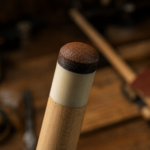
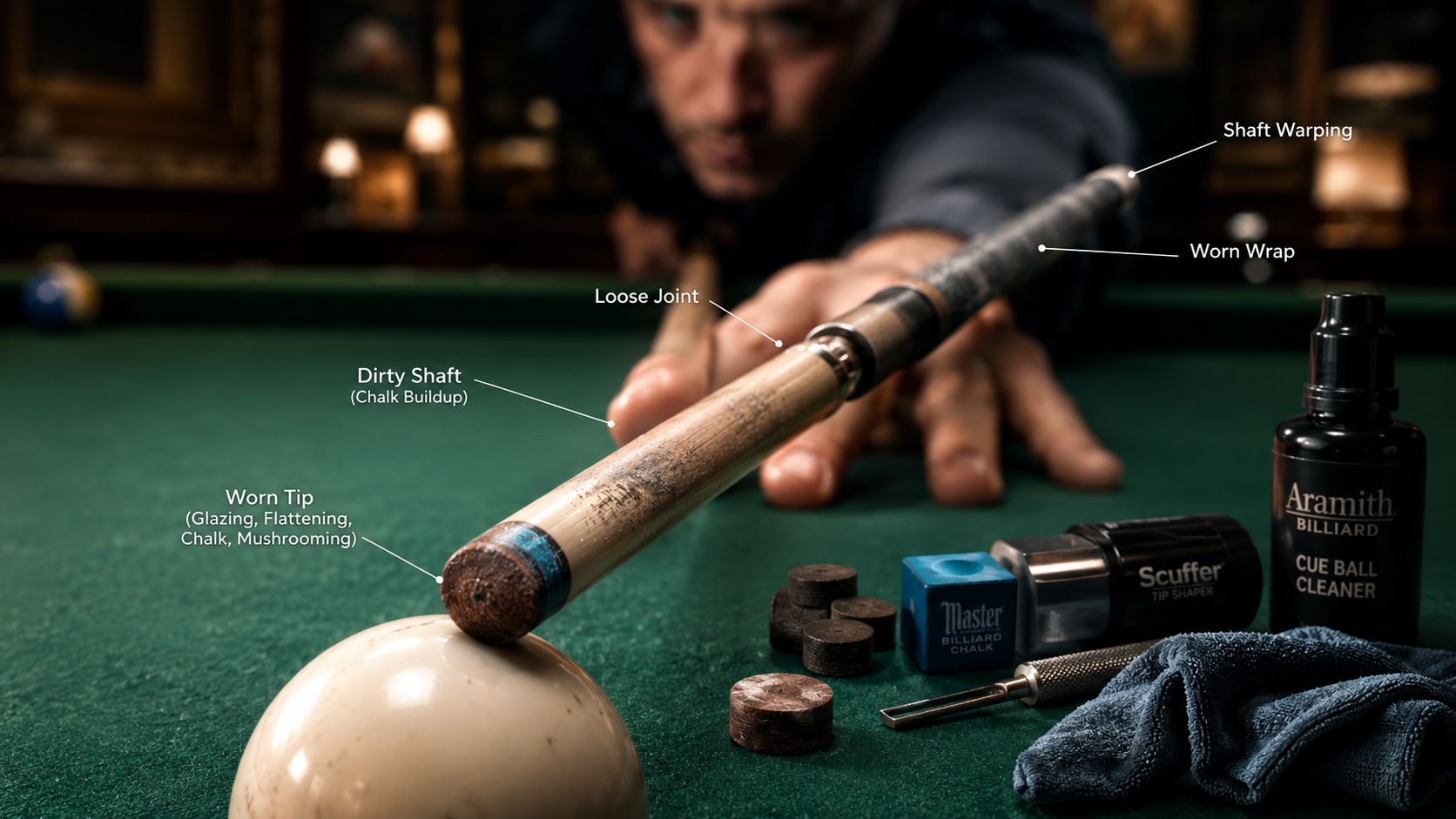
Tips wear in two primary ways. First, they flatten. A tip that starts with a nickel or dime radius gradually loses that curve and becomes flat, which reduces its ability to hold chalk and maintain a centered contact point. Second, they harden and glaze. The leather compresses and closes up over time, becoming slick and unresponsive — almost glassy on the surface.
Either way, a worn tip can't do its job. No amount of chalking will compensate for a tip that's lost its shape or texture.
What to look for:
- Run your finger over the tip surface — it should feel slightly rough, like fine leather. If it feels smooth or hard, it's glazed.
- Look at the profile from the side. It should be rounded. If it's flat, or if the edges are flaring out past the ferrule (mushrooming), it's due for attention.
- Check the thickness. If the tip is very thin and you can see the ferrule getting close to the ball on impact, replacement is overdue.
What to do:
If the tip is in early decline — flattened but still thick — a tip pick and shaper can restore the texture and radius and buy you more time. If it's glazed, hardened, mushroomed, or thin, it needs to be replaced.
A professionally installed new tip will transform how your cue feels. Players who've been playing on a deteriorated tip for months are often genuinely surprised at the difference — it can feel like a completely different cue. Learn more about our professional cue tip replacement service and what to expect from the process.
2. Your Shaft Needs Cleaning
If the tip checks out but something still feels off, look at the shaft. This is one of the most overlooked maintenance issues in pool, and it affects your game in a way that's surprisingly hard to identify.
Over time, chalk dust, skin oils, and environmental grime build up on the shaft surface. What you end up with is an uneven, slightly tacky surface that creates inconsistent friction as the cue slides through your bridge hand. Instead of a smooth, controlled stroke, you're fighting subtle resistance — or unexpected slippage — that disrupts your timing without you ever realizing the shaft is the cause.
What a dirty shaft feels like:
- The cue feels sticky or drags through your bridge hand instead of sliding cleanly
- Your stroke timing feels slightly off, even when your mechanics are sound
- Inconsistency that seems random and hard to pin down
What to do:
Wipe the shaft down with a slightly damp cloth after every session — this alone prevents most buildup. For more significant grime, a dedicated shaft cleaner or a very light pass with 0000-grade steel wool along the grain will restore a smooth surface. Avoid furniture polish, silicone sprays, or anything oil-based; these can penetrate the wood and permanently alter its feel and response.
For carbon fiber shafts, a damp microfiber cloth is all you need — no abrasives.
3. The Joint Has Loosened
The joint is where your shaft screws into the butt. It's easy to ignore because it usually works fine — until it doesn't.
A joint that has developed any looseness or wobble changes the way energy travels through the cue. Instead of a direct, crisp transfer from your stroke to the cue ball, you get a slightly dampened, imprecise feel. It can also produce a subtle vibration or rattle on contact that wasn't there before.
What a loose joint feels like:
- The hit feels softer or less responsive than it used to
- There's a slight vibration, wobble, or hollow sound on contact
- The cue feels mechanically “loose” even when you've screwed it together
What to check:
After assembling the cue, try gently twisting the shaft relative to the butt without unscrewing it. There should be zero play. Any movement at all is a problem.
What to do:
First, make sure the joint is simply clean — chalk and grime in the threads can prevent a full, secure connection. Clean both sides with a dry cloth or a soft toothbrush and reassemble. If the joint still has play after cleaning, the threads or the joint collar may be worn, and professional repair is the right call. A loose joint that's ignored tends to get worse, not better.
4. Your Wrap Has Worn Smooth
The wrap — whether it's Irish linen, leather, or rubber — provides the grip and feel in your back hand during the stroke. It's another part that degrades gradually, so gradually that most players don't notice until the change in feel is significant.
What a worn wrap feels like:
- Your back hand feels less secure during the stroke, especially on power shots
- The cue feels like it wants to shift in your grip
- The grip area feels slick, particularly with any moisture from your hand
What to do:
Irish linen wraps can often be revived slightly by cleaning with a dry cloth, but once the texture is genuinely gone, replacement is the fix. Leather wraps benefit from occasional conditioning. If you've been playing for years on the same wrap, it's worth having it looked at — a fresh wrap is an inexpensive improvement that a lot of players don't think to make.
5. The Cue Has Warped
Warping is less common than the other issues on this list, but it does happen — particularly with wooden shafts that have been stored improperly, left in a hot car, or exposed to changes in humidity over time.
A warped shaft introduces deflection into every shot. The cue ball goes somewhere slightly different than where you aimed, and no amount of adjustment seems to fully correct it because the error is baked into the equipment, not your technique.
How to check:
Roll the cue on a flat, level surface like a pool table. A straight cue will roll smoothly and evenly. A warped one will wobble or rock as the bend passes through the low point of each rotation. You can also hold the cue up and sight down the shaft from the tip end, the way you'd look down the barrel of something — any curve will be visible.
What to do:
Minor warps in wooden shafts can sometimes be corrected by a professional with the right tools and technique. Significant warps usually mean it's time for a new shaft. Carbon fiber shafts are virtually warp-proof — if you've had repeated problems with your wooden shaft in humid New England conditions, that's worth knowing.
Quick Diagnosis: What's Most Likely Your Problem
| What You're Experiencing | Most Likely Cause |
|---|---|
| Miscues, loss of spin, poor chalk retention | Worn or glazed tip |
| Sticky or inconsistent stroke | Dirty shaft |
| Dead, dampened feel on contact | Loose joint or worn tip |
| Slipping in your back hand | Worn wrap |
| Shots going consistently off-target | Warped shaft |
| General inconsistency across everything | Start with the tip — it's almost always the tip |
The Bottom Line
A cue that feels different almost always has a fixable cause. The tip is the right place to start in nine out of ten cases — it's the part that wears fastest, affects performance the most, and is the most straightforward to address professionally.
If you're in the Central Massachusetts area and your cue hasn't felt right lately, I'm happy to take a look. Whether it needs a new tip, a shaft cleaning, or something more involved, I'll give you an honest assessment and get it back to where it should be. Reach out through the service request page and we'll go from there.
And if you want to understand how all these components — tip, ferrule, shaft, joint, and more — work together as a system, our complete guide to pool cue anatomy breaks it all down in detail.
Billiard Greg's Cue Repair proudly serves pool players in Worcester and throughout Central Massachusetts.